
The Empowerment Community | 501(c)(3) Nonprofit | www.TheEmpowermentCommunity.org | Family Court Reform Initiative | Version 5.0 · July 2026
Protecting Children and Families From Coercive Control
The Parental Alienation Informed Disclosure
A model legal framework to make parental alienation education and safety screening mandatory in every U.S. custody case.
Model Legislation · Presented to All 50 States · Version 5.0, June 2026
Prepared for Presentation to State and Federal Legislators • A Proposed Act
Executive Summary
22M+
Americans affected by parental alienation (Harman et al., 2018)
9-15%
of children in divorcing families experience PA (Fidler & Bala, 2010)
80%
of custody cases involve some degree of programming (Clawar & Rivlin, 2013)
0
states currently require mandatory PA disclosure at divorce
Parental alienation — the systematic psychological manipulation of a child to reject a loving parent — is a recognized form of child abuse and coercive control. Yet family courts across the United States routinely operate without standardized protocols to identify, disclose, or respond to this harm. Children suffer lasting developmental damage. Targeted parents face legal ruin. The alienating parent continues to act with impunity.
This Act fills that gap through three primary mechanisms:
1. MANDATORY DISCLOSURE
Family courts shall provide every parent and child (by age-appropriate means) with a standardized Informed Disclosure Form describing the psychological harms of parental alienation, coercive control, and custodial interference — the legal consequences of engaging in such conduct — and each party's rights under existing law.
2. MANDATORY SAFETY SCREENING
Courts shall administer a validated domestic violence and coercive control screening instrument at the commencement of every custody proceeding, with results preserved in the court record.
3. GRADUATED ENFORCEMENT
A tiered sanctions framework — from judicial notice through contempt, modification of custody, and criminal referral — shall apply to documented alienating behaviors, with particular attention to Encouragement of Abandonment, Custodial Interference as Kidnapping, and Civil Conspiracy to deny parental access.
The evidence base for these provisions spans three decades of peer-reviewed research, DSM-5-TR clinical classification, and federal statutory authority. This Act is fully consistent with the Fourteenth Amendment right to family integrity and with federal mandates under ICWA, VAWA, and the Child Abuse Prevention and Treatment Act.
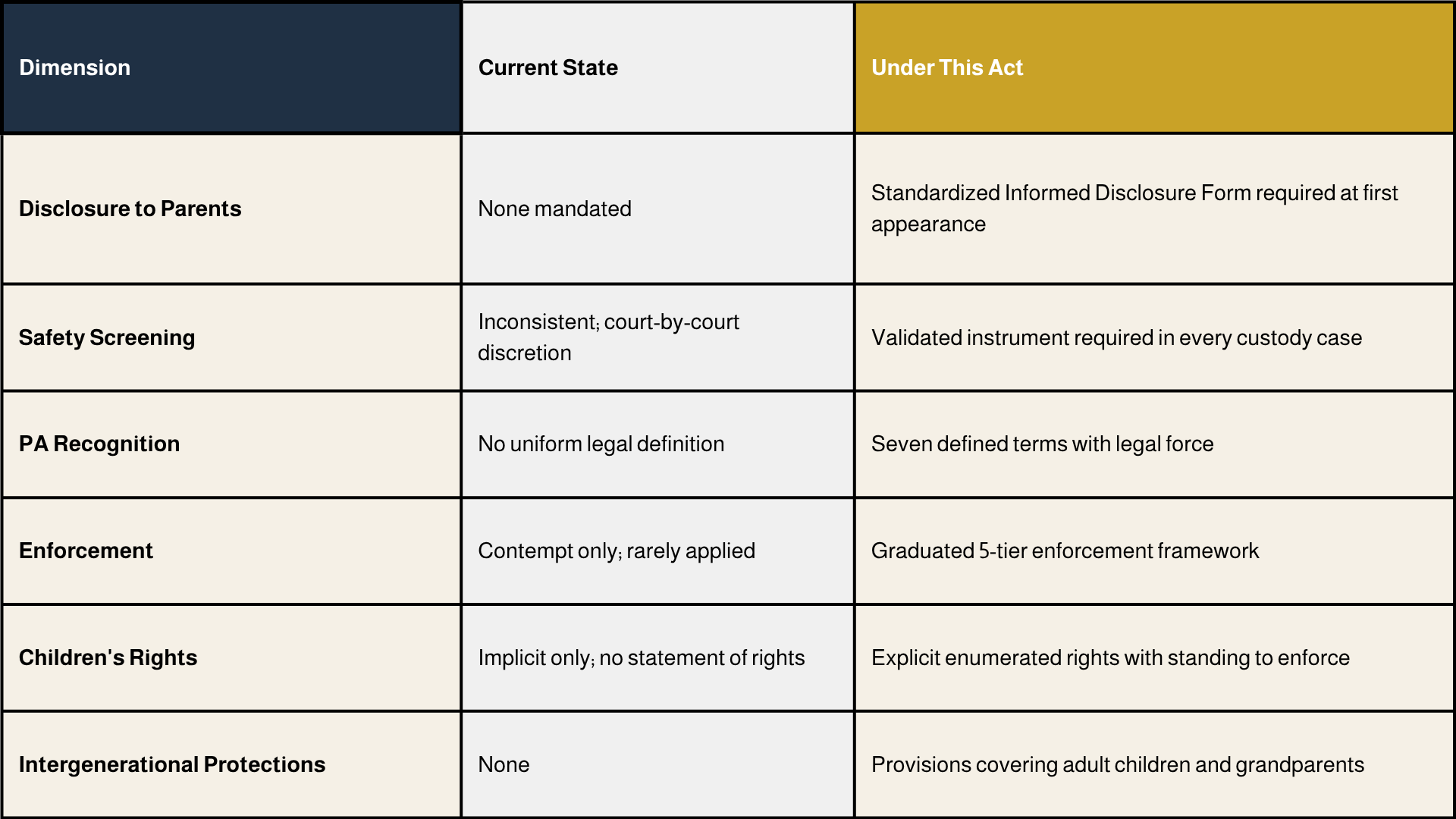
Current State vs. Under This Act
Section 1 - Legislative Findings
The [State/Federal] Legislature finds and declares:
PREVALENCE. An estimated 22 million Americans are affected by parental alienation, making it one of the most common yet least-addressed forms of family dysfunction encountered in the court system. (Baker, 2005; Harman et al., 2018)
PSYCHOLOGICAL HARM. Parental alienation causes severe, documented psychological harm to children, including anxiety, depression, substance abuse, impaired attachment, and life-long relationship difficulties. (Gardner, 2002; Warshak, 2010; Clawar & Rivlin, 2013)
NEUROLOGICAL HARM. Deliberate induction of fear toward a safe parent produces measurable structural changes to the developing brain — including amygdala hyperactivation, hippocampal volume reduction, prefrontal thinning, and white matter demyelination. (Teicher & Samson, 2016)
ADVERSE CHILDHOOD EXPERIENCES. Exposure to parental conflict and psychological abuse is directly linked to increased lifetime risk for depression, substance abuse, chronic disease, and premature mortality. (CDC/Kaiser ACE Study, 1998)
CLINICAL RECOGNITION. The DSM-5-TR (2022) recognizes Parent-Child Relational Problem (V61.20 / Z62.820) and Child Psychological Abuse (995.54 / T74.32) as applicable diagnoses for parental alienation syndrome in children.
COERCIVE CONTROL. Parental alienation is a recognized form of coercive control — a pattern of behavior that seeks to take away the victim's liberty or freedom and strip away their sense of self. (Stark, 2007; VAWA Reauthorization Act, 2022)
COURT FAILURES. Family courts have been found to apply inconsistent standards, lack uniform screening instruments, and inadequately respond to documented parental alienation, resulting in unjust custody orders and ongoing child harm. (Fidler et al., 2013; NAM Report, 2019)
KNOWLEDGE GAP. Parents and children appearing in family court regularly lack information about their rights, the documented harms of alienating behaviors, and the legal consequences of engaging in or permitting such conduct.
CONSTITUTIONAL FOUNDATION. The fundamental liberty interest of parents in the care, custody, and control of their children is constitutionally protected. Troxel v. Granville, 530 U.S. 57 (2000).
FEDERAL AUTHORITY. Congress has authority under the Commerce Clause, Spending Clause, and Fourteenth Amendment to establish minimum standards for child safety and family integrity in federally funded programs, including Title IV-D and Title IV-E of the Social Security Act.
Section 2 - Definitions
As used in this Act, the following terms shall have the meanings set forth below:
2.1 — Parental Alienation (PA)
A pattern of behavior by one parent (the "alienating parent") that psychologically manipulates a child to reject, fear, or show unwarranted hostility toward the other parent (the "targeted parent"), without legitimate justification. Includes, but is not limited to: denigration campaigns, interference with contact, emotional manipulation, false allegations, and programming.
2.2 — Coercive Control
A course of conduct — including acts of assault, threats, humiliation, and intimidation — used to harm, punish, or frighten a partner or family member, rendering them subordinate and/or dependent by depriving them of their liberty, exploiting their resources, and preventing their escape. Coercive control includes the systematic use of parental alienation as a tool of domestic abuse. (Stark, 2007; VAWA, 2022)
2.3 — Encouragement of Abandonment
Any act or course of conduct by a parent or third party that actively encourages, permits, or facilitates a child's unilateral rejection or abandonment of a parent-child relationship, including: (a) affirming the child's refusal to communicate or visit; (b) failing to take reasonable steps to enforce a custody order; or (c) presenting abandonment to the child as acceptable or desirable.
2.4 — Custodial Interference as Kidnapping
The act of taking, enticing, detaining, or concealing a child from the child's lawful custodial parent in violation of a court order or the other parent's legal custodial rights, where such conduct is sustained, willful, and perpetrated in bad faith. This Act clarifies that sustained custodial interference constitutes a form of parental abduction subject to existing state and federal kidnapping statutes where applicable.
2.5 — Civil Conspiracy (Family Court Context)
An agreement between two or more persons — including attorneys, relatives, or third-party influencers — to undertake a course of conduct that intentionally deprives a parent of court-ordered parental rights, facilitates parental alienation, or obstructs the administration of a custody order. Civil conspiracy in this context is actionable under state tort law and may give rise to sanctions under court rules.
2.6 — Targeted Parent
A parent who is the subject of parental alienation, coercive control, or systematic interference with their parental rights by the other parent, a third party, or both. Being a targeted parent does not in itself confer fault or absence of fault with respect to the underlying marital relationship.
2.7 — PA-Informed Disclosure
A written disclosure, in plain language, provided to each party in a custody proceeding, describing: (a) the nature and documented harms of parental alienation; (b) the legal consequences of alienating behaviors; (c) each parent's rights under the custody order and applicable law; and (d) each child's rights.
Section 3 - Mandatory Requirements
3.1 — Mandatory Informed Disclosure
(a) TIMING. At the commencement of any custody or parenting-time proceeding — or upon entry of any initial custody order — the court shall cause the PA-Informed Disclosure Form to be provided to each parent. Courts shall also provide an age-appropriate version to any child aged 7 or older who is subject to the proceeding, upon request or by court direction.
(b) ACKNOWLEDGMENT. Each parent shall sign a written acknowledgment of receipt and confirm that the contents of the Disclosure Form have been explained to them. This acknowledgment shall be filed in the court record.
(c) LANGUAGE ACCESS. The PA-Informed Disclosure Form shall be made available in any language spoken by a party to the proceeding. Courts shall not proceed substantively until disclosure has been provided in a language the party understands.
(d) ATTORNEY CERTIFICATION. Counsel of record shall certify to the court that they have reviewed the Disclosure Form with their client. Pro se parties shall receive additional orientation from court staff.
3.2 — Mandatory Safety Screening
(a) INSTRUMENT. Every court adjudicating child custody or parenting time shall administer a validated domestic violence and coercive control screening instrument to each party at the commencement of the proceeding. Validated instruments include the Danger Assessment (DA), the DVSI-R, the PC-CTS, or an equivalent instrument approved by the state family court administrator.
(b) CONFIDENTIALITY. Screening results shall be maintained in a confidential portion of the court file, accessible only to the court, appointed professionals (e.g., GAL, forensic evaluator), and counsel of record.
(c) RESPONSE PROTOCOL. Where screening results indicate elevated risk, the court shall: (1) order a full forensic evaluation; (2) appoint a Guardian ad Litem if one is not already serving; and (3) consider interim protective measures pending final order.
3.3 — Prohibited Conduct
No parent, guardian, or third party subject to or participating in a custody proceeding shall engage in any of the following:
✦Pattern of denigration of the other parent in the presence of the child
✦Interference with or obstruction of the child's telephone, electronic, or in-person contact with the other parent
✦Making or encouraging false allegations of abuse, neglect, or unfitness without good-faith factual basis
✦Psychological manipulation of the child to reject or fear the other parent
✦Enlisting third parties — including relatives, therapists, or educators — in a campaign of alienation
✦Removing or concealing the child from the jurisdiction without prior court approval
✦Engagement in Encouragement of Abandonment as defined in Section 2.3
3.4 — Required Conduct
Each parent subject to a custody order shall:
✦Actively facilitate the child's relationship with the other parent, including ensuring the child is available for all court-ordered contact
✦Refrain from discussing adult litigation issues with the child in a manner that places the child in a loyalty conflict
✦Promptly notify the court and opposing counsel if the child refuses court-ordered contact, and take reasonable steps to address the refusal
✦Provide the other parent with timely notice of significant events in the child's life
✦Cooperate with any court-ordered reunification therapy, parenting coordination, or forensic evaluation
Section 4 - Children’s Rights
This Act recognizes the following rights of every child who is the subject of a custody proceeding:
✦The right to a safe, loving relationship with both parents, free from psychological manipulation, coercion, or programming
✦The right to be free from adult litigation conflict and from exposure to denigrating statements about either parent
✦The right to have the court receive and consider the child's expressed preferences, commensurate with the child's age and maturity
✦The right to be represented by an independent advocate (Guardian ad Litem or child's attorney) in any proceeding involving allegations of parental alienation
✦The right to receive age-appropriate disclosure about the nature of these proceedings and their rights thereunder
✦The right to reunification services when a parental relationship has been disrupted by alienation or interference
✦The right to seek judicial enforcement of these rights through a Guardian ad Litem upon reaching the age of majority, or directly upon reaching age 18
4.1 — Intergenerational Protections
(a) ADULT CHILDREN. Where alienation has persisted into adulthood, adult children who were subjected to a campaign of parental alienation during their minority shall have standing, in a court of competent jurisdiction, to seek a declaratory judgment regarding the existence of parental alienation, and to pursue civil remedies against the alienating parent.
(b) GRANDPARENTS. Grandparents and other extended family members who have been denied access to a child as part of an alienation campaign may petition the family court for reunification services and restored contact, consistent with the best interests of the child.
The ACE Connection: The CDC/Kaiser Permanente ACE Study established that adverse childhood experiences — including exposure to parental conflict and psychological abuse — are directly linked to increased lifetime risk for depression, substance abuse, chronic disease, and premature mortality. Parental alienation is an ACE. This Act is child protection legislation.
Section 5 - Enforcement & Sanctions
Courts shall apply a graduated enforcement framework to documented violations of the conduct standards established in Section 3. The following tiers are cumulative and shall be applied proportionately to the nature, frequency, and severity of the conduct.

First Documented Instance of Prohibited Conduct
Sanction: Written judicial notice; mandatory completion of PA-awareness parenting class (8 hours). Authority: Court rule; inherent authority.

Repeated Instances or Substantial Interference with Custody Order
Sanction: Civil contempt; compensatory parenting time (2× missed time); payment of other party's attorney's fees. Authority: State contempt statutes; court rule.

Sustained Campaign or Willful Non-Compliance with Tier 1/2 Sanctions
Sanction: Modification of custody; transfer of primary custody to targeted parent; appointment of parenting coordinator at alienating parent's expense. Authority: Best-interest standard; family court jurisdiction.
Encouragement of Abandonment or Custodial Interference as Kidnapping
Sanction: Criminal referral to prosecuting authority; suspension of custody rights pending criminal proceedings; protective order for targeted parent and child. Authority: State criminal code; PKPA; UCCJEA.

Civil Conspiracy or Coordinated Third-Party Alienation Campaign
Sanction: Civil tort action; sanctions against participating professionals; bar complaint referral for attorneys who facilitate alienation. Authority: State tort law; court rules; bar rules.
5.1 — Rebuttable Presumption
Where a parent has been found by the court to have engaged in documented parental alienation as defined in Section 2.1, there shall be a rebuttable presumption that the child's best interests are served by primary placement with the targeted parent, subject to appropriate reunification support and ongoing court supervision.
This presumption may be rebutted by clear and convincing evidence that :
✦Placement with the targeted parent poses a safety risk to the child;
or
✦The targeted parent is otherwise unfit to serve as primary custodian.
5.2 — Protection from Retaliation
No parent who reports alienating conduct to the court, or who seeks enforcement of their rights under this Act, shall be subjected to adverse legal presumptions on account of such reporting. Courts shall sanction any party who brings a retaliatory motion in bad faith.
Section 6 — Implementation
Courts shall apply a graduated enforcement framework to documented violations of the conduct standards established in Section 3. The following tiers are cumulative and shall be applied proportionately to the nature, frequency, and severity of the conduct.
6.1 — Rulemaking (180 Days)
Within 180 days of enactment, the State Court Administrator shall promulgate rules and forms implementing this Act, including: an approved PA-Informed Disclosure Form in all required languages; a list of approved safety screening instruments; a model parenting class curriculum; judicial bench cards summarizing the enforcement framework; and a model parenting coordination agreement for Tier 3 cases.
6.2 — Judicial Training (270 Days)
Within 270 days of enactment, every judge and court commissioner who adjudicates family law matters shall complete a minimum of 4 hours of training on the identification and legal response to parental alienation and coercive control, to be provided by the state judicial college or an approved provider.
6.3 — Annual Reporting
Each court shall annually report to the Administrative Office of the Courts:
✦The number of custody cases in which PA-Informed Disclosure was provided
✦The number of cases in which safety screening identified elevated risk
✦The number of enforcement actions taken under Section 5
✦Outcomes data on cases involving reunification services
6.4 — State Implementation Guidance
States adopting this disclosure are encouraged to:
✦Incorporate this form by statute or court rule as a mandatory filing in all divorce, dissolution, legal separation, and child custody proceedings
✦Require judicial officers to confirm on the record that both parties have signed and been provided a copy of this disclosure before entering any custody or parenting plan order
✦Treat a signed disclosure as admissible evidence in any subsequent contempt, modification, child protection, or custody proceeding
✦Provide this disclosure in all primary languages spoken in the jurisdiction, with interpreter services available
✦Pair this disclosure with mandatory co-parenting education that includes parental alienation content and trauma-informed parenting practices
✦Cross-reference with state child abuse reporting requirements, domestic violence protocols, and guardian ad litem standards
Section 7 — Research & Legal Foundation
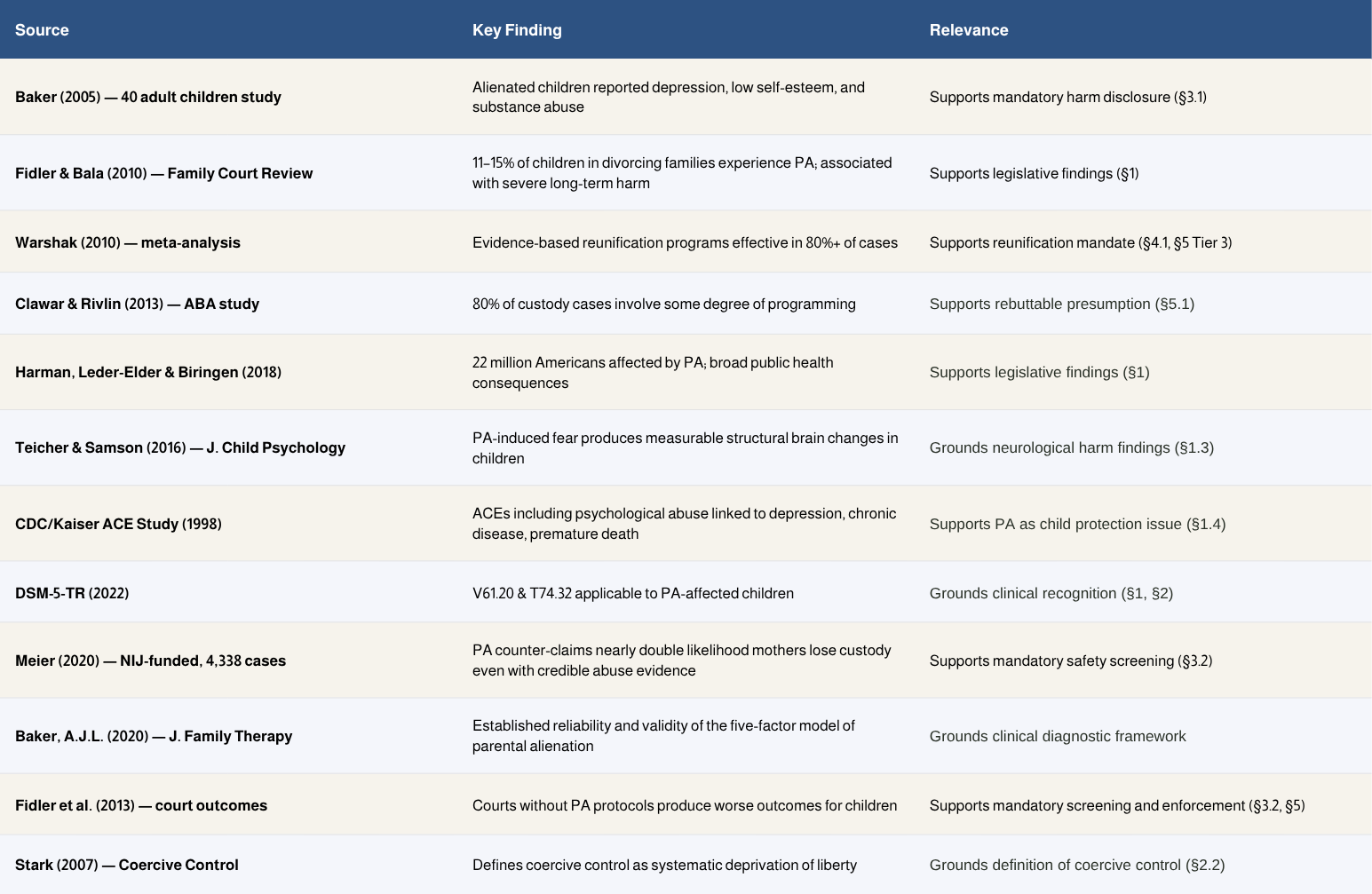
Key Research Citations
Federal Statutory Framework
This Act is grounded in and consistent with existing federal law:
✦Violence Against Women Act (VAWA), 42 U.S.C. § 13925 et seq. — Recognizes coercive control as domestic violence; grounds federal funding for family court programs.
✦Parental Kidnapping Prevention Act (PKPA), 28 U.S.C. § 1738A — Prohibits custodial interference across state lines; grounds §2.4 of this Act.
✦International Parental Kidnapping Crime Act (IPKCA), 18 U.S.C. § 1204 — Makes international removal of a child to obstruct parental rights a federal felony (up to 3 years).
✦Child Abuse Prevention and Treatment Act (CAPTA), 42 U.S.C. § 5101 et seq. — Requires states to address child psychological abuse as condition of grant funding.
✦Title IV-D and IV-E, Social Security Act, 42 U.S.C. §§ 651–669b, 670–679c — Federal child support and foster care funding tied to state custody enforcement standards.
✦Indian Child Welfare Act (ICWA), 25 U.S.C. § 1901 et seq. — This Act is fully consistent with ICWA's tribal sovereignty protections.
✦42 U.S.C. § 1983 — When state agencies or court-appointed professionals fail to enforce custody orders or ignore documented alienation, affected parents may have civil rights claims for deprivation of the fundamental liberty interest in the parent-child relationship.
Grant Alignment & Funding Pathways
This Act and the programs it establishes are aligned with the following federal grant programs and funding streams. Organizations and state agencies implementing this legislation are encouraged to pursue funding through these sources:
CAPTA State Grants
42 U.S.C. § 5106a
The Child Abuse Prevention and Treatment Act requires states receiving grants to address child psychological abuse. PA disclosure and screening programs qualify directly as CAPTA-eligible activities.
VAWA Family Court Programs
34 U.S.C. § 12291 et seq.
VAWA funding supports training, screening, and service programs addressing coercive control in family court. This Act's mandatory screening and judicial training components are directly VAWA-eligible.
Title IV-D Access & Visitation
42 U.S.C. § 669b
Federal Access and Visitation grants fund mediation, supervised visitation, parent education, and enforcement of parenting time orders. All core mechanisms of this Act qualify.
Title IV-E Prevention
42 U.S.C. § 671 et seq.
The Family First Prevention Services Act (2018) allows Title IV-E funds to support evidence-based prevention services, including family therapy and parent skills training, before court involvement escalates.
DOJ Children Exposed to Violence
OJJDP / OVC Funding
Department of Justice programs (OVC, OJJDP) fund programs addressing children's exposure to violence, including psychological abuse in the home. PA qualifies as an adverse childhood exposure.
SAMHSA Behavioral Health Grants
Substance Abuse and Mental Health Services Administration
Reunification therapy, trauma-informed care, and mental health services for alienated children and targeted parents align with SAMHSA's Children and Families program priorities.
CDC Violence Prevention
Centers for Disease Control and Prevention
CDC's Adverse Childhood Experience (ACE) prevention grants support programs that reduce childhood trauma. PA-awareness and prevention programs directly address ACE reduction goals.
Private & Foundation Funding
Family court reform, child welfare, and domestic violence foundations increasingly recognize PA as a fundable issue. Alignment with DSM-5-TR classification, ACE research, and VAWA strengthens competitive applications.
For Grant Writers:
For Grant Writers: This Act's statutory framework, research citations, and federal alignment make it suitable as a foundation for grant applications. Key qualifying language includes: child psychological abuse prevention (CAPTA), coercive control screening (VAWA), enforcement of parenting time orders (Title IV-D §669b), trauma-informed services for children (SAMHSA), and ACE reduction programming (CDC). Contact The Empowerment Community for a grant-ready program narrative template.
Take Action in Your State
How to Present This Proposal to Your Legislator:
This proposal is designed to be taken directly to state legislators by any concerned parent, advocate, or professional. When meeting with your legislator:
✦Lead with the child welfare angle. This is child protection legislation. PA is classified as Child Psychological Abuse under DSM-5-TR and meets CAPTA's definition of harm.
✦Emphasize the disclosure mechanism. Mandatory disclosure costs the court very little and creates an immediate deterrent effect. Most legislators support informed consent as a baseline.
✦Reference the federal funding alignment. CAPTA, VAWA, and Title IV-D grants are already available — state legislation unlocks them.
✦Bring the research packet. The citations in Section 7 are from peer-reviewed journals and federal statutory text. This is not a political claim — it is a clinical and legal one.
✦Ask for a co-sponsor before the bill is drafted. Bipartisan sponsorship is achievable — targeted parent advocacy crosses party lines.
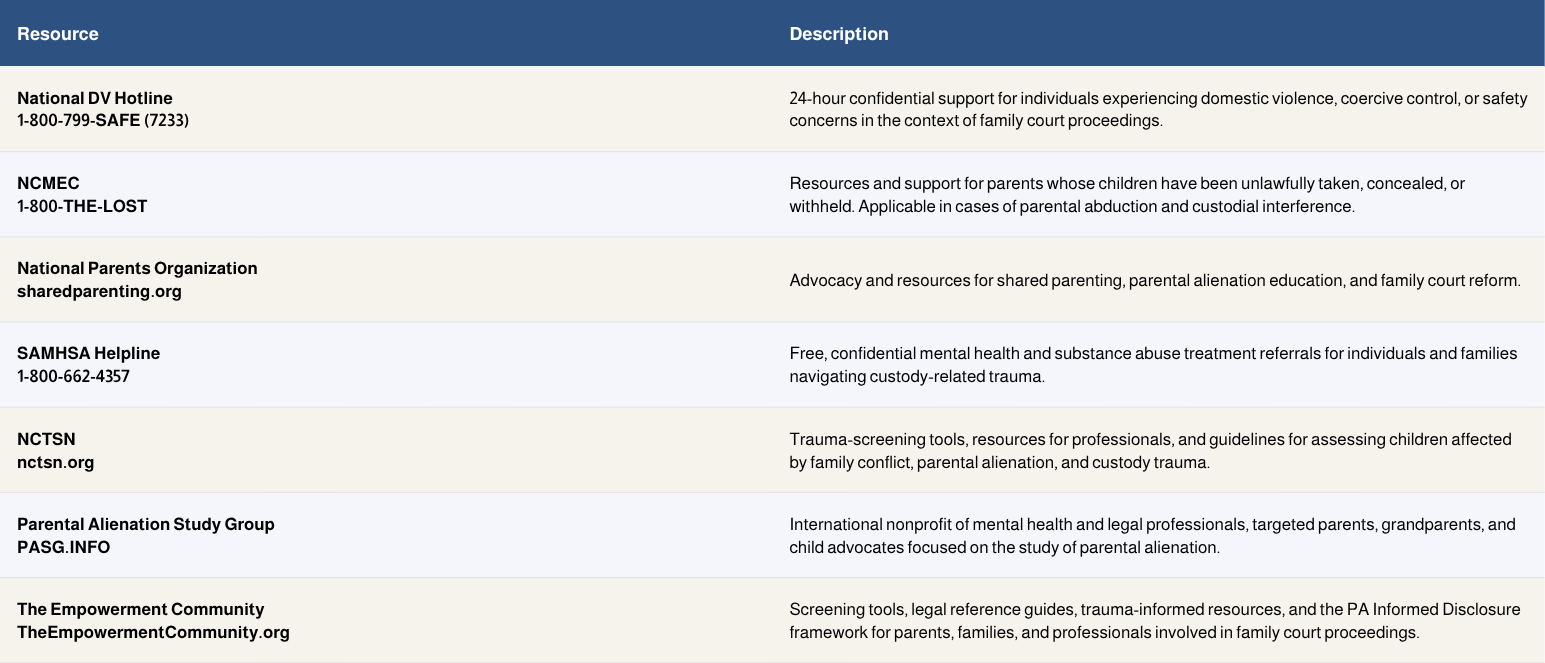
Resources & Support Organizations
Legislator ToolKit
This model legislation is designed to be introduced in any state. The full bill text, companion disclosure form, research packet, judicial training outline, and implementation guide are available from The Empowerment Community.